
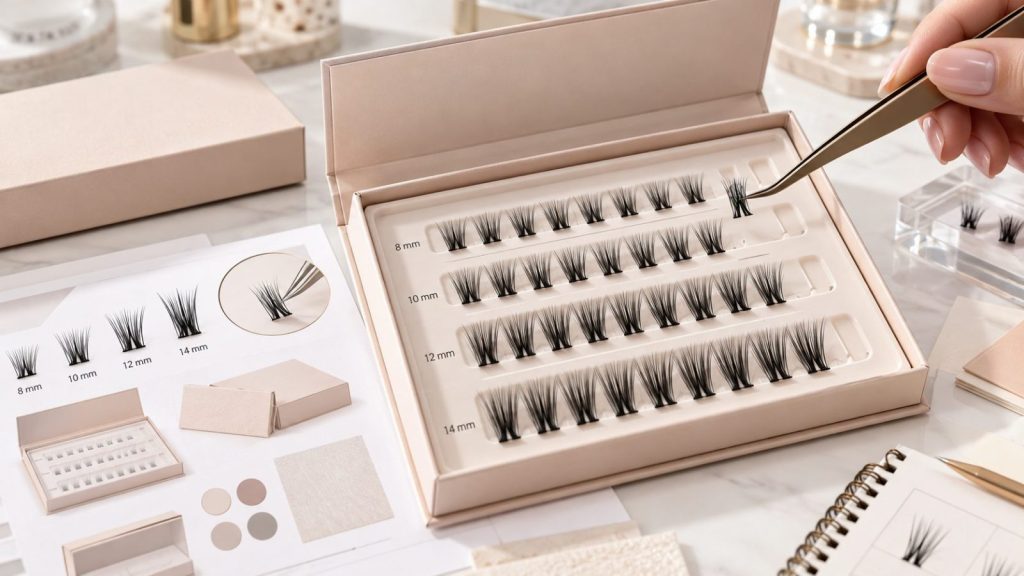
When a beauty brand develops pre-glued lash clusters, most of the early attention naturally goes to the lashes themselves.
The brand may compare the finished look, cluster density, length mix, curl, softness, base construction and pre-glued application experience.
But there is another part of the product that can directly affect how customers experience it:
the tray.
A pre-glued lash cluster can look excellent inside the box and still feel inconvenient if the clusters are difficult to pick up, the lengths are hard to identify, the rows are arranged poorly, or the tray does not work well with the final packaging.
For private label brands, tray design should therefore be reviewed as part of product development rather than treated as a simple packaging detail at the end.
This guide explains what buyers should discuss with a manufacturer before approving a pre-glued lash cluster tray for production.
Why the Tray Matters More for Pre-Glued Lash Clusters
With conventional false lashes, packaging mainly protects and presents the product.
With pre-glued lash clusters, the tray can also influence the application process.
The user normally needs to identify the desired cluster, grip it with tweezers, remove it from the tray without unnecessarily disturbing the lash shape or pre-glued base, and then place it in the intended position.
This means the tray affects more than appearance.
It can influence:
- how easily customers understand the product;
- how quickly they can find different lengths;
- how comfortably they can grip a cluster;
- whether nearby clusters interfere during pickup;
- how neatly the product remains arranged before use;
- and how professional the complete kit feels.
If your brand is still deciding whether pre-glued clusters are the right format, our pre-glued cluster lash guide provides a broader overview of the product category.
1. Start With the Pickup Experience
One of the first questions to test is simple:
Can the customer remove each cluster comfortably with tweezers?
A tray may look attractive in a product photo but still create problems during actual use.
For example, difficulties can occur if:
- the lash base sits too close to a tray surface;
- there is not enough space for the tweezer tip;
- adjacent clusters are positioned too closely;
- the tray edge blocks a natural pickup angle;
- or the cluster moves in an unexpected way when lifted.
Some brands may therefore prefer a tray structure that gives the user more access around the base of the cluster.
This can involve adjustments to the shape, recess, edge or angle of the area where the lashes are positioned.
There is no single tray geometry that is automatically best for every pre-glued cluster.
The correct solution depends on the cluster construction, placement method, inner tray material and actual user behavior.
For this reason, pickup should be tested with physical samples rather than approved only from a drawing or packaging render.
2. An Angled or More Accessible Tray Can Be Worth Testing
For some pre-glued cluster formats, brands may find that a more accessible presentation angle makes the clusters easier to grip.
This does not mean every tray needs the same angle or structure.
The important point is to evaluate whether the customer can approach the cluster base naturally with the intended tweezers.
During development, ask the manufacturer to show how the clusters sit inside the tray and, where possible, compare more than one tray presentation if pickup feels difficult.
A useful test is to have someone who did not participate in product development try the sample for the first time.
If that person immediately understands where to grip and can remove several clusters consistently, the tray is doing part of its job well.
If they repeatedly change tweezer position, touch neighboring clusters or struggle to reach the base, the tray deserves another review.
3. Decide How Different Lengths Should Be Arranged
Many DIY cluster lash products contain more than one length so customers can build a complete lash map.
The arrangement inside the tray should make those lengths easy to understand.
Possible planning questions include:
- Should shorter lengths begin on one side and increase progressively?
- Should each length have its own clearly separated section?
- How many clusters of each length should be included?
- Should the same length appear in one row or more than one row?
- Will the layout still be easy to understand after some clusters have been removed?
The best layout depends on the actual kit concept.
A tray designed for one complete natural lash map may need a different arrangement from a refill product or a tray intended for customers who create multiple looks.
Do Not Let the Layout Become a Guessing Game
If several lengths look visually similar, relying on appearance alone can create unnecessary confusion.
A customer should not have to compare individual fibers every time they want to know which section contains 10 mm, 12 mm or another length.
Clear organization becomes especially important after the product has already been opened and partially used.
4. Length Labels Should Be Easy to Read
Length identification is a small detail that can have a large effect on usability.
Depending on the packaging system, length information may be printed or displayed near the relevant row or tray section.
Before production, review:
- where the length information appears;
- whether it remains visible when the tray is inside the box;
- whether customers can match each label to the correct row;
- whether the text is large enough to understand comfortably;
- and whether the design remains clear across all planned tray configurations.
A beautiful visual design should not make practical information harder to find.
5. Cluster Spacing Affects Both Presentation and Pickup
Spacing is another area that should be tested rather than judged only by appearance.
If clusters are positioned very closely together, the tray can look full and visually impressive.
However, the user also needs enough working space to select one cluster without interfering with another.
On the other hand, excessive spacing can make the product presentation look sparse or require a larger tray than necessary.
The objective is to find a practical balance between:
- clean visual presentation;
- efficient tray use;
- clear separation between clusters;
- and comfortable pickup.
The correct spacing should be validated using the actual cluster style and actual intended tray—not assumed from another product.
6. The Tray Must Match the Final Outer Packaging
Private label brands sometimes develop the lash style first and discuss the outer box later.
This can create problems if the selected tray dimensions do not fit the desired package, or if the package design hides information that should remain visible.
Before final approval, confirm the relationship between:
- inner tray dimensions;
- outer box dimensions;
- opening direction;
- clear window or viewing area, if used;
- printed inserts or instructions;
- tweezer storage, if the kit includes tweezers;
- and any other components included in the kit.
If your brand plans customized packaging, it is useful to review the product and packaging together rather than approve them as completely separate projects.
You can also read our guide on reviewing logo and packaging samples before a private label lash order.
7. Think About Starter Kits and Refill Products Early
Even if the first launch includes only one box format, it is useful to consider whether the product may later expand into:
- a starter kit;
- refill packs;
- different length combinations;
- different style combinations;
- or multiple tray sizes.
A tray system that works well for one product may become difficult to manage if every future SKU requires a completely different layout.
This does not mean every future product must use the same tray.
It simply means the brand should think ahead about which parts of the system are intended to stay consistent and which parts may change.
8. Do Not Approve the Tray Only from a Digital Design
Artwork and 3D packaging views are useful for confirming visual direction, but they cannot fully show how a pre-glued cluster feels during pickup.
Before approving bulk production, the brand should review a physical sample whenever practical.
The sample review can include:
- overall tray appearance;
- cluster positioning;
- pickup accessibility;
- length arrangement;
- label readability;
- tray stability inside the box;
- and the complete opening and application experience.
If more than one person is involved in the brand, it can also be useful to let several people test the sample rather than relying on only the person who designed the product.
For a broader sampling process, see our guide on how to compare lash samples from different suppliers.
9. Create a Final Approved Reference Before Bulk Production
Once the brand is satisfied with the tray, the approved version should be clearly identified before production begins.
That reference may include the approved:
- lash style;
- length configuration;
- quantity by section or row;
- tray arrangement;
- printed length labels;
- outer packaging;
- and any included accessories.
The objective is to reduce ambiguity when the order moves from sampling into manufacturing.
If something is changed after approval, the updated version should be confirmed clearly rather than allowing different teams to work from different references.
A Practical Tray Approval Checklist
| Item to Check | Question for the Brand |
|---|---|
| Pickup access | Can the customer grip and remove each cluster comfortably? |
| Tray geometry | Does the tray shape or presentation angle support natural tweezer access? |
| Cluster spacing | Can one cluster be selected without disturbing nearby clusters? |
| Length layout | Is the sequence of lengths easy to understand? |
| Length labels | Can customers quickly identify each section? |
| Outer packaging fit | Does the tray fit and display correctly inside the final box? |
| Kit components | Is there enough space for instructions, tweezers or other planned items? |
| Physical sample | Has the actual tray been tested before bulk production? |
| Final approval | Is there one clearly confirmed production reference? |
FAQ About Pre-Glued Lash Cluster Tray Design
Does a pre-glued lash cluster tray need to be angled?
Not necessarily. An angled or more accessible tray structure may improve pickup for some product designs, but the correct geometry depends on the lash cluster, tray and intended application method. It should be tested with physical samples.
Should different lash lengths be separated in the tray?
They should at least be easy for the customer to identify. The exact arrangement can vary, but the length sequence and labeling should make the intended lash map understandable.
Can the same tray be used for every pre-glued cluster style?
Not automatically. Different cluster widths, quantities, length mixes and kit concepts may require different layouts. A brand can keep a consistent design system while still adjusting the tray where necessary.
Should I approve the tray and outer box separately?
They can be developed as separate components, but final approval should consider how they work together. Tray dimensions, visibility, opening direction, labels and accessories all affect the finished product.
Should the tray be tested before a bulk order?
Yes. A physical sample allows the brand to evaluate pickup, spacing, labels, fit and the complete user experience in ways that a digital rendering cannot fully show.
Developing a Pre-Glued Lash Cluster Tray for Your Brand
A good pre-glued cluster product is not only about the lash fibers or the adhesive at the base.
The complete customer experience also depends on how the product is organized, presented and removed from the tray.
For private label brands, the best time to solve tray issues is during sampling—not after thousands of finished boxes have already been produced.
Pingdu Lashes private label development can include discussion of lash style, tray configuration, packaging and other product details based on the actual project requirements.
If you are developing a pre-glued lash cluster product, you can contact us with your target style, preferred length combination, packaging idea and any reference product or tray you would like us to review.
We can then discuss which details should be confirmed during the sample stage before bulk production.


Conversation