
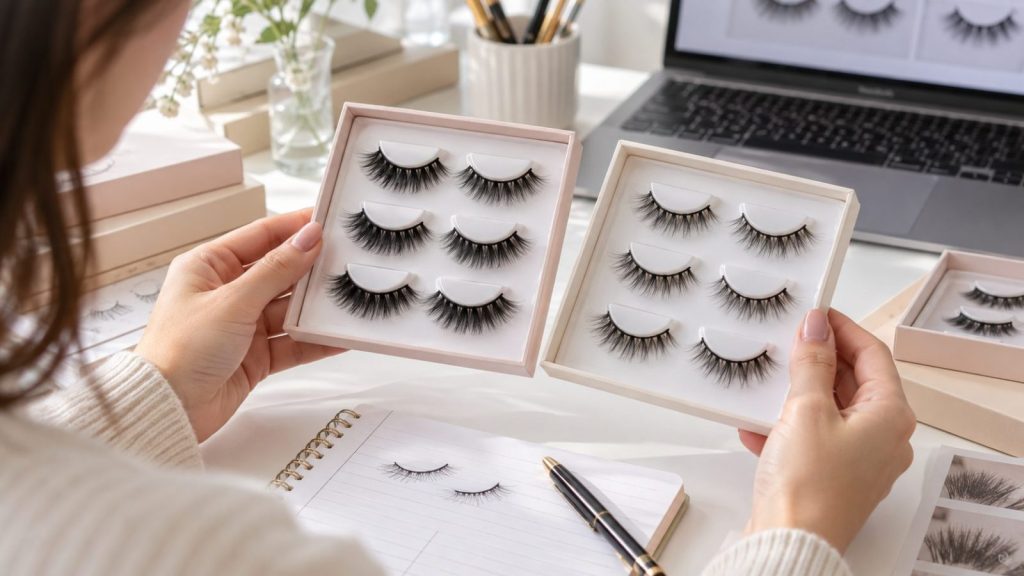
Your first lash order sold well.
Customers liked the style, reviews were positive, and the product became one of the SKUs you felt confident reordering.
Then the repeat order arrived.
Suddenly, customers started saying things such as:
- “These feel different from the last ones.”
- “The lashes are stiffer.”
- “They do not look as fluffy anymore.”
- “The curl is different.”
- “The band feels thicker.”
- “This used to be my favorite style, but the new one does not look the same.”
For an established lash brand, this situation can be more serious than receiving a bad first sample.
The first production batch has already created a customer expectation. Once customers recognize and repurchase a specific lash style, even relatively small changes may become noticeable.
The important question is therefore not simply:
“Is the new batch good?”
It is:
“Is the new batch still the product my customers originally bought?”
Quick Answer: Why Do Customers Sometimes Complain After a Lash Reorder?
Customer complaints after a repeat lash order may indicate that something has changed between production batches.
Possible differences can involve:
- fiber softness or surface finish
- curl
- visible length
- density
- layering
- spike or wispy placement
- band thickness or flexibility
- cluster base construction
- tray arrangement
- packaging or SKU identification
However, one customer complaint does not automatically prove that the whole production batch is wrong.
The first step should be to determine whether the feedback is isolated or whether several customers are describing the same change.
1. Do Not Dismiss “It Feels Different” as a Vague Complaint
Beauty customers do not normally describe products using manufacturing specifications.
They describe the wearing experience.
A customer may not say:
“The fiber specification appears to have changed.”
She may simply say:
“These lashes feel harder than before.”
She may not say:
“The density distribution is different.”
She may say:
“They do not look as fluffy.”
This means customer feedback can contain useful product information even when the wording is subjective.
| Customer Feedback | What the Brand May Need to Check |
|---|---|
| “They feel stiffer.” | Fiber feel, band or base construction, overall flexibility |
| “They are not as fluffy.” | Density, layering, fiber distribution |
| “They look shorter.” | Visible length, curl, lash mapping |
| “The shape changed.” | Overall pattern, symmetry, length transition, outer-corner design |
| “The band is uncomfortable now.” | Band thickness, flexibility, curvature or construction |
| “The new ones do not look like my old pair.” | Direct comparison with the previous approved product |
The goal is to translate customer language into specific areas that can be physically compared.
2. First Check Whether You Have a Pattern
Before contacting the manufacturer and saying that the whole order has changed, collect the available evidence.
Useful information may include:
- which SKU the customer purchased
- when the customer purchased it
- photos of the product received
- the customer’s exact complaint
- whether the customer purchased the previous version before
- whether similar complaints are appearing from other customers
- whether returns or refund reasons show the same pattern
If several previous customers independently describe the same difference, the feedback becomes much more useful.
For example, five returning customers saying that the same SKU feels noticeably stiffer deserves a different investigation from one first-time customer simply saying that she does not like the style.
3. Compare Three Products If You Still Have Them
One of the best ways to investigate a repeat-order complaint is to compare physical products rather than relying only on messages.
If possible, place these three references together:
- the originally approved sample
- a product retained from the successful first production order
- products from the current repeat order
This comparison can answer an important question.
Did the repeat order move away from the product that was originally approved?
Check the products under the same lighting and compare the same SKU.
Depending on the lash category, review:
- overall visual shape
- left-right symmetry
- fiber direction
- curl
- length balance
- density
- layering
- spike placement
- softness
- band or base
- tray presentation
If you no longer have an approved sample, an unopened unit from the first successful order can become an extremely valuable reference.
We discuss this process in more detail in our guide on using an older lash product as a reference when quality changes.
4. The Real Problem May Be That the Product Was Never Properly “Locked”
Many repeat-order problems begin much earlier than the repeat order itself.
The first order may have been approved using only:
- a supplier photo
- a WhatsApp conversation
- a general style name
- a catalog number
- the instruction “same as sample”
That may be enough to complete one order.
But once the product becomes a successful SKU, the brand needs a stronger production reference.
A repeatable product record may include:
- approved physical sample
- internal product code
- SKU name
- reference photographs
- confirmed length direction
- curl
- density or styling reference
- band, base or tray requirements
- approved packaging artwork
- label and barcode version
- any modifications made during sampling
The purpose is not to create unnecessary paperwork.
The purpose is to make sure that six months later, the next production team is not trying to recreate your bestseller from a message saying:
“Please make exactly the same as last time.”
5. “Same Style Number” Does Not Always Tell the Whole Story
A product code is useful, but serious brands should not depend on the code alone.
A style may still require control over characteristics such as:
- fiber appearance
- curl profile
- length distribution
- density
- layering
- band or base construction
- tray format
- packaging version
This becomes especially important when a brand has several similar-looking SKUs.
Two lashes may look almost identical in a catalog photograph while customers can clearly feel or see the difference when wearing them.
6. A Strong Supplier Should Investigate the Difference, Not Just Say “It Is the Same”
How the manufacturer responds to a repeat-order complaint tells you a great deal about the supplier relationship.
A weak response is:
“We made the same product. There is no problem.”
A more useful investigation is:
- confirm the affected SKU
- confirm which production order the product came from
- review the approved reference
- compare retained samples if available
- review the specific characteristics customers mentioned
- check whether the issue appears across multiple units
- identify what should be corrected before the next production run
This does not mean every customer complaint will prove a manufacturing error.
But a long-term manufacturing partner should be able to investigate a complaint systematically rather than simply arguing that nothing changed.
7. Ask the Manufacturer One Important Question
When a bestseller starts receiving complaints after a reorder, ask:
“What exact reference did you use to reproduce this SKU?”
The answer can reveal a lot.
Was production based on:
- an approved physical sample?
- a detailed specification?
- a confirmed internal product code?
- reference photographs?
- a previous retained production sample?
- or simply the product name from the previous purchase order?
The more commercially important the SKU becomes, the less you want production to depend on memory.
8. Your Bestselling SKU Needs More Control Than a Slow-Moving SKU
Not every product requires the same level of repeat-order management.
If one lash style becomes responsible for a meaningful share of your sales, that SKU deserves stronger controls.
You may want to keep:
- an unopened product from each successful production batch
- the approved master sample
- current packaging files
- SKU photographs
- customer feedback records
- notes about previous revisions
This creates a simple product history.
If something changes later, you have something concrete to compare against.
9. Do Not Fix a Reorder Problem by Quietly Changing the Product Again
When customers begin complaining, there can be pressure to solve the issue quickly.
But making another undocumented adjustment can create a third version of the same SKU.
For example:
Version A was the original bestseller.
Version B was the problematic reorder.
Version C was modified to fix Version B.
If these changes are not clearly recorded, the next reorder can become even more confusing.
A better process is:
- identify what changed
- define which version is the target
- make a controlled revised sample
- approve the revised standard
- record the new reference
- use that reference for future production
10. Test the Corrected Product Against the Original Bestseller
Do not evaluate the replacement sample only by asking whether it looks good.
Compare it directly with the version customers originally loved.
If you are comparing products from several manufacturers, you can also use the same principle described in our guide on how to compare lash samples from different suppliers.
The target is not necessarily to find the most impressive-looking sample.
The target is to reproduce the characteristics your existing customers already recognize.
11. Customer Complaints Can Reveal a Supplier Management Problem
A quality complaint is sometimes treated as an isolated defective-product issue.
For a growing beauty brand, it may reveal something larger.
If the same type of inconsistency repeatedly appears between orders, the underlying problem may involve how the supplier manages:
- approved samples
- product specifications
- SKU records
- production references
- packaging versions
- changes between orders
- quality feedback
This is why long-term supplier performance should not be judged only by the quality of the first sample.
Established brands need a manufacturer that can reproduce successful products repeatedly as the business grows.
You can read more about this in our guide on how established beauty brands evaluate OEM lash manufacturers for long-term supply.
12. When Should You Start Testing Another Manufacturer?
One complaint does not automatically mean you need to replace your supplier.
However, it may be reasonable to test another manufacturing option if:
- repeat orders repeatedly differ from approved products
- the supplier cannot explain which reference was used
- the same quality issue returns after correction
- product specifications are not clearly recorded
- approved modifications are repeatedly forgotten
- different SKUs are frequently confused
- the supplier dismisses documented customer feedback without investigation
You also do not necessarily need to move your entire collection at once.
A practical approach is to begin with the affected bestseller or one representative SKU.
If maintaining the existing product is important, see our guide on switching lash suppliers without changing your existing products.
13. What Should You Send a New Lash Manufacturer?
If you want another manufacturer to evaluate the problem, do not begin by saying only:
“My current supplier’s quality is bad.”
Send useful comparison information.
This may include:
- the original product customers liked
- the current reorder customers are complaining about
- photos of both versions
- the affected SKU
- customer feedback
- your current packaging
- any available specifications
- the approximate reorder quantity
- which characteristics must remain unchanged
A physical comparison between the successful version and the problematic version can often communicate more than a long written explanation.
14. The Goal Is Not a Perfect First Order. It Is a Repeatable Bestseller.
Many suppliers can prepare one attractive sample.
Many can also produce one successful first order.
The more important test begins after the product starts selling.
Can the manufacturer reproduce that product when:
- you reorder months later?
- your quantity increases?
- you add more SKUs?
- packaging changes?
- different production cycles are involved?
For a growing lash brand, this is where manufacturing becomes part of brand management.
Your customers do not know which factory produced Batch 1 or Batch 2.
They only know that they bought the same product name twice and expected the same experience.
What to Do If Your Customers Are Already Complaining
If you are already receiving complaints about a repeat lash order, start with one affected SKU.
- Collect several customer comments.
- Keep samples from the current batch.
- Find an older unit that customers liked.
- Compare the products side by side.
- Identify the most obvious differences.
- Ask the manufacturer what production reference was used.
- Decide whether the current supplier can correct and control the product.
- If necessary, test the SKU with another manufacturer before moving larger orders.
This is usually more useful than changing suppliers immediately without understanding what actually changed.
How Pingdu Lashes Can Help
Pingdu Lashes works with beauty brands, distributors and private label lash businesses that need product matching, sample development and more controlled repeat-order production.
If one of your existing lash products has changed between orders, you can send us:
- photos of the older product your customers liked
- photos of the current product
- a physical reference sample if available
- the customer complaints you are receiving
- your SKU information
- packaging photos or files
- estimated order quantities
We can first compare the product direction and identify what should be matched or tested before discussing a larger production order.
You do not need to move your entire collection first. Start with the SKU that is causing the problem.
Frequently Asked Questions
Why would the same lash SKU feel different in a repeat order?
Several product characteristics can affect the final wearing experience, including fiber feel, curl, density, length distribution, band or base construction and overall styling. The first step is to compare the repeat order directly with the originally approved product rather than assuming the cause.
Should I complain to my lash supplier after one customer reports a problem?
Record the feedback first and check whether similar comments appear from other returning customers. A repeated pattern across the same SKU provides stronger evidence than one isolated opinion.
What is the most useful reference for a repeat-order quality problem?
An approved physical sample or an unopened product retained from a successful previous production batch can be extremely useful. It provides a real reference for appearance, construction and feel.
Do I need to change lash suppliers if the second order is different?
Not automatically. First determine what changed and whether the current manufacturer can identify the cause, reproduce the approved standard and prevent the same problem from recurring. If the issue repeatedly returns, testing another manufacturer may be reasonable.
Can a new manufacturer copy my existing bestseller exactly?
A current product or approved sample can be used as a development reference, but physical sample testing is still important. The objective should be to match the product characteristics that matter to your customers and establish a controlled specification for future production.
Should I move my whole lash collection to a new supplier?
Usually there is no need to move everything immediately. Brands can begin by testing one bestseller, one problematic SKU or one product due for reorder before making a larger supply-chain decision.


Conversation