
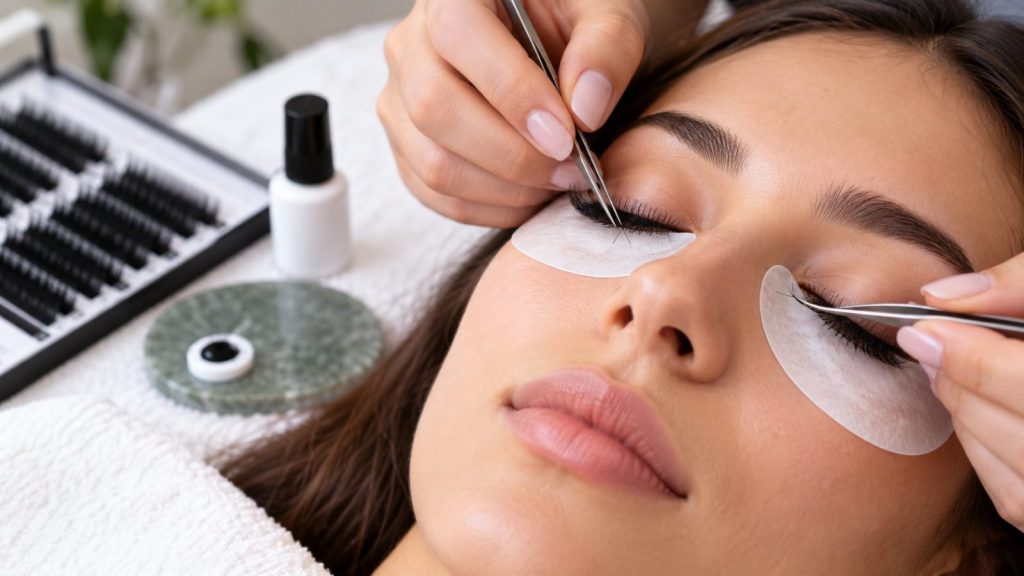
One of the most noticeable beauty trends of 2026 is surprisingly subtle.
Instead of extremely dark, thick or dramatic lashes, more beauty looks are allowing natural lashes to remain visible. The term “ghost lashes” is being used to describe this barely-there effect: lashes may be left completely natural, lightly curled or finished with very little product.
At first glance, that may sound like bad news for false lash and lash extension brands.
It is not necessarily.
For lash brands and manufacturers, the more useful question is not whether consumers will stop wearing lashes. The question is whether the definition of an attractive lash result is changing.
In 2026, more consumers are showing interest in lashes that improve the eyes without looking heavily styled.
What Does “Ghost Lashes” Actually Mean?
The original ghost-lash trend is mainly a makeup aesthetic.
It does not describe one specific type of lash extension, cluster lash or strip lash.
That distinction is important for private label brands.
A manufacturer should not simply take a standard false lash, reduce the density slightly and rename it “Ghost Lashes.” That would confuse a trend with a product category.
Instead, brands should treat ghost lashes as a market signal.
The signal points toward:
- less visible weight;
- less obvious black density;
- more separation between fibers;
- softer definition;
- more visible natural lash line;
- an overall result that looks less constructed.
Ghost lashes are therefore more useful as a product-development direction than as a literal product name.
Why Is the Market Moving Away from Heavy Volume?
Heavy volume is not disappearing.
There will always be customers who want dramatic lashes, strong eye definition and highly visible volume.
The change is that heavy volume is no longer the only definition of a premium lash result.
Minimal makeup, softer skin finishes and more natural brows have changed the balance of the face. When the rest of the makeup becomes lighter, extremely dense lashes can sometimes feel disconnected from the overall look.
That creates space for another type of lash product: a lash that improves the eye shape without dominating the face.
For brands, this is important because “natural” no longer means simply making an existing dramatic lash shorter.
A genuinely natural-looking lash may require changes in density, fiber distribution, color, curl, length progression and even the way the fibers separate from each other.
What Could This Trend Mean for Lash Product Development?
For private label brands, the ghost-lash trend can be translated into several practical product-development directions.
1. Lower Visual Density
Natural-looking lashes need visible space.
When too many fibers are concentrated together, the lash line immediately looks darker and heavier.
A softer design allows the eye and natural lash line to remain visible.
2. More Controlled Length
More length does not always create a more premium result.
For a barely-there effect, the difference between the natural lash and the extension or false lash should feel restrained.
Length progression should enhance the eye shape instead of becoming the first thing the customer notices.
3. Softer Color Options
Black will remain the core color of the lash market, but softer black and brown options can become more relevant when brands want to create a lower-contrast result.
This does not mean every brand needs a brown collection.
It means color should be considered part of the visual-density decision rather than treated separately.
4. Lighter Fiber Structure
Fiber structure can also change how dense a finished lash looks.
For example, flat-base or split-tip structures can create different visual effects from conventional round fibers.
Brands developing a softer collection may therefore need to test not only the number of fibers, but also how individual fibers look once applied.
Pingdu Lashes already develops professional options such as Flat Lash Extensions and Cashmere Split-Tip Flat Lash Extensions, which can be evaluated when a brand wants to explore different visual weights and tip effects.
Does This Mean Dramatic Lashes Are Going Out of Style?
No.
This is one of the most important mistakes brands should avoid.
Beauty trends rarely move in only one direction.
Natural lashes, manga lashes, wet-look sets, spikes, heavy volume and DIY clusters can all exist in the market at the same time because they serve different consumers and different occasions.
A strong product strategy therefore does not require a brand to replace its dramatic collection.
Instead, it may require adding a different visual category.
Dramatic / Glam Collection
Strong definition, visible density and more obvious styling.
Soft / Natural Collection
Lower density, softer lengths, more separation and lower visual contrast.
The opportunity is not necessarily to abandon one market.
It is to make sure the brand is not offering only one interpretation of beauty.
What Should Private Label Brands Test in Samples?
When developing a softer lash collection, brands should not approve samples only by looking at the tray.
A lash that looks natural inside the box may look completely different once applied.
During sample evaluation, check:
- how dark the lash line appears;
- whether individual fibers remain visible;
- whether the finished look hides too much of the natural lash;
- whether the longest points feel excessive;
- whether the curl looks too dramatic;
- whether the product looks natural from normal conversation distance, not only in macro photography;
- whether the result still feels intentional rather than simply “thin.”
This last point is especially important.
Natural does not mean empty.
A successful barely-there product still needs shape, balance and a clear design purpose.
The Bigger Lesson Behind Ghost Lashes
The most valuable part of the ghost-lash trend is not the name itself.
Trend names can disappear quickly.
Consumer preferences usually change more slowly.
The important signal is that a growing part of the beauty market is becoming more comfortable with products that are less obvious.
For lash brands, that means future product development may need to think less about “How can we make this lash look bigger?” and more about “How can we make the customer’s eyes look better while making the product itself less noticeable?”
That is a very different product-development question.
And it may become one of the most important questions for natural lash collections in 2026 and beyond.
FAQ
Are ghost lashes a specific type of false lash?
No. Ghost lashes originally describe a minimalist makeup look where natural lashes are left bare or only lightly enhanced. Lash brands can use the trend as inspiration for softer product development, but it should not automatically be treated as a separate product category.
Can lash extensions create a ghost-lash-inspired effect?
They can create a softer, lower-density result inspired by the same aesthetic, but the result depends on length, density, fiber structure, curl and application design.
Should private label brands stop developing volume lashes?
No. Natural and dramatic products serve different customers. The better strategy is usually to understand whether a softer collection could complement the existing range.
What should brands focus on when developing natural-looking lashes?
Brands should evaluate density, length progression, curl, color, fiber structure, separation and the final applied effect rather than judging the lash only inside the tray.
Develop a Softer Lash Collection with Pingdu Lashes
If your brand is exploring lighter, softer or more natural-looking lash products, physical sample development is the best way to compare different structures and visual effects before bulk production.
Contact Pingdu Lashes to discuss your target look, reference product and private label requirements.
Conversation