
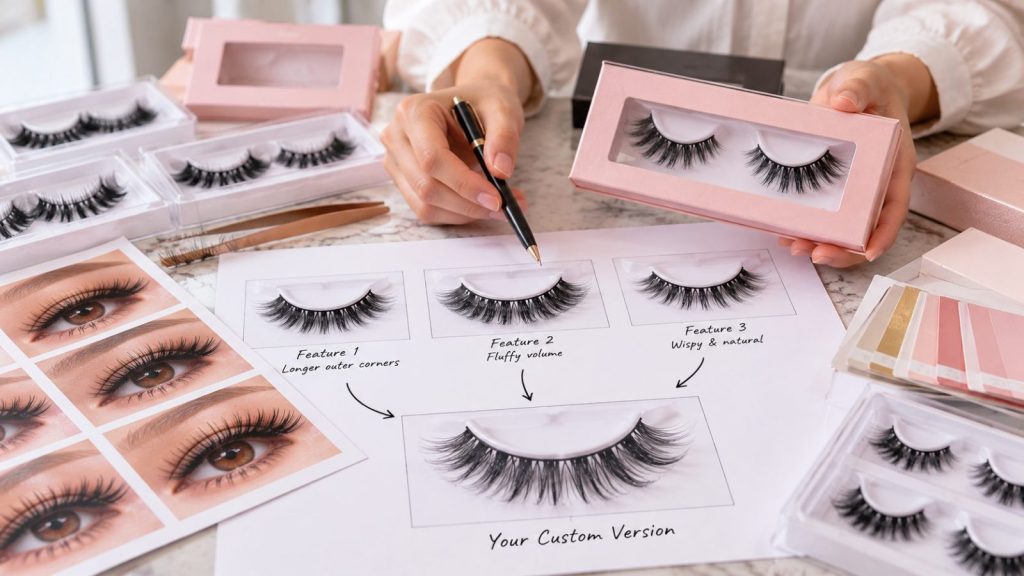
Yes. If you like different features from several lash products, those references can be used together to develop a new direction for your own brand.
You do not have to find one existing lash product that is exactly what you want.
Many beauty brands begin product development with several references.
For example, you may like:
- the overall shape of one lash
- the density of another
- the spikes from a third product
- the band from another strip lash
- the color of another style
- the tray or packaging presentation from another product
The manufacturer can use these references to understand the direction you want to develop.
The important part is not simply sending several photos.
You should explain what you like in each reference and what you do not want copied from it.
You Do Not Need One Perfect Reference Product
First-time private label buyers sometimes think they must find one existing lash product that is almost identical to the product they want to launch.
That is not necessary.
A product-development conversation can begin with several different visual references.
For example:
Reference A: you like the overall Cat Eye shape.
Reference B: you prefer the lighter density.
Reference C: you like the defined spikes.
Reference D: you prefer the softer-looking band.
These references can be discussed together.
The objective is to define your own target product rather than automatically reproduce one existing item.
What Features Can Be Combined?
The exact features depend on the lash category.
For strip lashes, brands may compare:
- overall lash shape
- center or outer-corner emphasis
- density
- length distribution
- layering
- wispy texture
- spike definition
- band appearance
- overall makeup effect
For cluster lashes, references may help communicate:
- cluster base direction
- length mix
- lash mapping
- density
- spiky or wispy texture
- overall application look
- tray layout
For professional lash extensions, the discussion may include:
- fiber appearance
- curl direction
- thickness direction
- length range
- fan or fiber structure
- tray configuration
- color direction
You do not need to know all of the technical names before contacting the manufacturer.
A clear visual reference can be enough to begin the discussion.
How Should I Send Several References to a Manufacturer?
The easiest method is to label each reference and explain the feature you want from it.
For example:
- Photo 1: I like the overall shape.
- Photo 2: I want a similar density.
- Photo 3: I like these spikes.
- Photo 4: I prefer this softer outer corner.
This is much more useful than simply sending four photos with no explanation.
You can also mark the images directly with arrows, circles or short notes.
If the reference comes from a TikTok video, Instagram post or product page, send the link together with a screenshot showing the part you want the manufacturer to notice.
Can I Use References from Different Lash Categories?
Sometimes, but the references still need to make sense for the product you are developing.
For example, you may like the visual effect of a lash extension set but want to develop a strip lash with a similar overall appearance.
That reference can help communicate the target look.
However, the final strip lash structure cannot simply be assumed to work exactly like professional extensions.
The manufacturer still needs to translate the visual idea into a product structure suitable for the chosen category.
This is why physical sample development is important.
Can the Manufacturer Copy Every Detail from Different Products?
The better approach is to use references for product direction, not as instructions to reproduce another brand’s product exactly.
Reference products can help communicate:
- shape
- density
- texture
- style direction
- application effect
- packaging preference
But your own product should be developed and confirmed as its own version.
This is especially important when references include another brand’s logo, artwork, trademarked elements or distinctive protected packaging.
If you already have one reference product that you want to modify, you can also read our guide on how a manufacturer can develop your own lash product from a reference.
What If I Only Know the Visual Effect I Want?
That is still enough to start.
You may not know:
- the exact length
- the exact curl
- the exact thickness
- the density
- the band structure
Instead, you may simply know:
“I want the center to look like this.”
“I want the outer corner softer.”
“I want stronger spikes but less density.”
“I want this shape, but more natural.”
These are useful product-development instructions.
The technical direction can then be discussed and tested through samples.
Can I Combine Natural and Dramatic Features?
Yes, if the final product remains visually balanced.
For example, a brand may want:
- a natural overall density
- clearer spikes
- a stronger center or outer-corner emphasis
- a softer band
That combination can become its own product direction.
The first sample may not be the final version.
It may need adjustment until the relationship between shape, density, texture and band appearance feels right.
Can I Combine Features to Create a Whole Lash Collection?
Yes.
You do not have to use the same combination for every style.
For example, a first collection could include:
- a soft everyday style
- a wispy style
- a Cat Eye direction
- a Doll Eye direction
- a stronger spiky style
Each product can share a common brand feeling while using different visual references.
This can help create a collection that looks connected without making every style look the same.
Should I Send Screenshots or Physical Samples?
Both can be useful.
Screenshots and product links are good for communicating the general direction quickly.
A physical product can provide more information when details such as structure, band, density or tray presentation matter.
You can begin with:
- screenshots
- product photos
- product links
- social media references
- makeup photos
- physical samples
The manufacturer can then tell you which reference needs closer confirmation.
How Does the Sample Process Work?
After the references are reviewed, the manufacturer should first summarize the target direction.
For example:
- overall shape from Reference A
- density direction from Reference B
- spike effect from Reference C
- band direction from Reference D
A physical sample can then be prepared based on that combined direction.
When you receive the sample, compare it with the result you originally wanted.
You can then give feedback such as:
- make the center longer
- reduce the density
- make the spikes clearer
- soften the outer corner
- change the band direction
The approved sample can then become an important reference for the final product.
Should Packaging Be Developed at the Same Time?
Branding and packaging can be discussed while the lash product is being developed.
However, important product and tray details should usually be clear before the final packaging dimensions are locked.
Private label packaging may include:
- logo
- brand colors
- product name
- style name
- SKU
- barcode
- product information
- tray presentation
- custom box artwork
If you want to confirm your branding before placing the first order, read our guide on seeing your logo and packaging on a sample before ordering.
What Should I Send the Manufacturer First?
You do not need a complete specification sheet.
Start with:
- 2–5 reference images or products
- a note explaining what you like in each reference
- the lash category you want to develop
- your target market
- estimated quantity
- number of styles
- your logo, if available
- your packaging direction, if available
The more clearly you explain the role of each reference, the easier it is to move from inspiration to a sample direction.
Develop Your Own Lash Product with Pingdu Lashes
Pingdu Lashes supports beauty brands with reference-based lash product development, physical sample confirmation, private label branding and packaging coordination.
If you like different features from several products, send the references together.
You can simply tell us:
- which shape you like
- which density you prefer
- which texture or spikes you want
- which features you do not want
- your target market
- your estimated quantity
- your branding and packaging direction
You do not need to combine the technical specifications yourself before contacting us.
The first goal is to define the product direction clearly enough to begin sample development.
Visit our Custom Lash Services page to discuss your product idea.
Conversation