
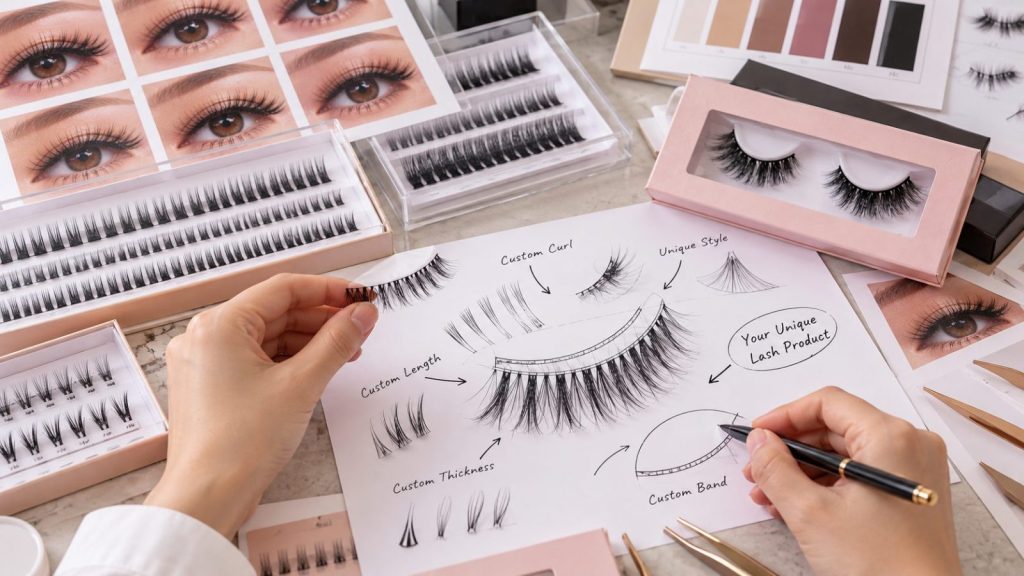
You do not need to invent a completely new type of eyelash to create a product that feels different from other brands.
At the same time, developing a private label lash product should not mean taking another brand’s finished product and asking a manufacturer to reproduce every detail exactly.
There is a practical middle ground.
You can study products you like, identify the features that attract you, decide what you want to change, and then develop a new version that fits your own brand, customer and product positioning.
For many beauty brands, this is how real product development begins.
You Do Not Need to Start from Zero
First-time brand owners sometimes think a custom lash product must be completely different from everything already on the market.
That is usually unrealistic.
Most lash products are built around familiar product categories and visual directions such as:
- natural
- wispy
- Cat Eye
- Doll Eye
- spiky
- Anime-inspired
- Wet Look
- soft glam
- dramatic volume
Your product does not need to invent a completely new category.
The opportunity is often in how you combine and adjust familiar elements.
What Can Make One Lash Product Feel Different from Another?
Two lashes can belong to the same general style category and still look noticeably different.
The difference may come from:
- overall shape
- length distribution
- center or outer-corner emphasis
- density
- layering
- spacing
- spike placement
- texture
- curl direction
- color
- band direction
- cluster base direction
- lash mapping
- tray presentation
This means a brand can work within a familiar product category while still developing its own recognizable direction.
Start by Identifying What You Actually Like
If you find a lash product you like, do not stop at:
“I want something like this.”
Try to identify the specific feature that makes you like it.
For example:
- I like the overall Cat Eye shape.
- I like the density, but I want fewer spikes.
- I like the center section, but I want a softer outer corner.
- I like the wispy texture, but I want a lighter finished look.
- I like the lash map, but I want a brown version.
- I like the product itself, but I want a different tray and packaging presentation.
This gives the manufacturer much more useful information than simply asking for an exact copy.
Change One Strong Element First
You do not always need to change everything.
Sometimes one or two meaningful adjustments are enough to create a different product direction.
For example, you may keep the general eye shape but change:
- the density
- the length contrast
- the spike rhythm
- the outer-corner balance
- the color
- the band appearance
A product can feel substantially different when these elements change together.
Example: Developing a Different Wispy Cat Eye Lash
Imagine that you like a popular Wispy Cat Eye Strip Lash.
Instead of asking the manufacturer to reproduce it exactly, you could define a new direction such as:
- keep the Cat Eye shape
- reduce the overall density
- make the spikes more separated
- soften the inner corner
- reduce the length difference between sections
- use a lighter-looking band direction
The result may still clearly belong to the Wispy Cat Eye category, but the finished product can have its own visual identity.
Example: Developing a New DIY Cluster Direction
The same approach can be used for cluster lashes.
You may like one existing DIY cluster product but want:
- more natural density
- clearer spikes
- a different mixed-length arrangement
- a softer inner-eye section
- a stronger Cat Eye or Doll Eye direction
- a different tray organization
These changes can be discussed before samples are developed.
The objective is to define the application result you want rather than copy another product point by point.
You Can Use More Than One Product as Inspiration
Sometimes one reference does not contain everything you want.
You may like:
- the shape of Product A
- the density of Product B
- the spikes of Product C
- the softer outer corner of Product D
These references can be reviewed together to define a new product direction.
If you are working this way, read our guide on combining features from several lash products into your own version.
What Should Not Be Copied?
Product references are useful for communicating style and performance direction.
However, another brand’s identity should not simply be reproduced.
Avoid treating the following as elements to copy directly:
- another brand’s logo
- brand name
- trademarked wording
- original artwork
- distinctive branded graphics
- protected packaging elements
Your own branding, artwork and packaging system should be developed for your brand.
The product reference should help communicate the lash direction, not replace your own brand identity.
Packaging Can Create Additional Differentiation
Product differentiation does not come only from the lashes themselves.
Two brands may sell products in the same general category while presenting them very differently.
Your private label presentation can include:
- your logo
- brand colors
- style naming system
- collection names
- SKU structure
- tray presentation
- product information
- lash mapping information
- application instructions
- custom box artwork
For an established beauty brand, the lash product can also be developed to match the visual system of your existing product line.
Do I Need Fully Custom Packaging to Make My Product Different?
No.
Packaging is one part of differentiation, but it is not the only part.
Your first priority should be to confirm that the lash product itself fits the market you want to serve.
Depending on your launch stage, you may begin with an existing packaging structure and add your branding, or move toward fully customized printed packaging when the project is ready.
Fully customized printed boxes generally have their own production minimum.
For Pingdu Lashes projects, fully customized printed boxes generally require around 1,000 pieces.
This packaging quantity does not automatically mean you must purchase 1,000 finished lash products in the first order.
You can learn more in our guide on custom lash packaging MOQ.
What If I Only Have One Competitor Product as a Reference?
That is still enough to begin a conversation.
Send the reference and explain:
- what you like
- what you do not like
- what you want to change
- who your target customer is
- how you want your brand to feel different
For example:
“I like the overall shape, but I want a softer and more natural version.”
Or:
“I like the spikes, but I want lower density and a more wearable everyday look.”
These instructions give the manufacturer a clear direction without requiring an exact copy.
You can also read our guide on developing your own lash product from a reference.
What If I Do Not Know the Technical Specifications?
You do not need to know every technical term before contacting a manufacturer.
You may not know the exact:
- length
- curl
- thickness
- density
- lash map
- band structure
You can still start with visual instructions.
For example:
- make it softer
- make the center more noticeable
- reduce the density
- make the spikes clearer
- make the outer corner longer
- make the overall effect more natural
The technical direction can then be discussed during product development.
Can One Product Idea Become a Small Collection?
Yes.
Once a strong product direction is defined, a brand can develop related variations around it.
For example, one core style may later become:
- a Natural version
- a fuller version
- a brown version
- a different eye-shape version
- a Strip Lash version
- a DIY Cluster version
This can help the brand build a recognizable product family instead of launching unrelated styles.
What Should I Send a Manufacturer?
You can begin with a very simple product-development brief.
Send:
- 1–5 reference photos or products
- what you like about each reference
- what you want to change
- the lash category you want
- your target market
- your sales channel
- estimated quantity
- number of styles
- your logo, if available
- your packaging direction, if available
You do not need to complete a professional technical specification sheet before the first conversation.
Develop a Lash Product for Your Own Brand with Pingdu Lashes
Pingdu Lashes supports beauty brands with reference-based product development, sample confirmation, private label branding and packaging coordination.
If you have seen a lash product you like but do not want to copy it exactly, send us the reference.
Tell us:
- which features you want to keep
- which features you want to change
- the overall effect you want
- your target customer
- your estimated quantity
- your branding and packaging direction
The first goal is not to copy another brand.
It is to define a product direction that makes sense for your own brand and can then be confirmed through physical samples.
Visit our Custom Lash Services page to discuss your product idea.
Conversation