
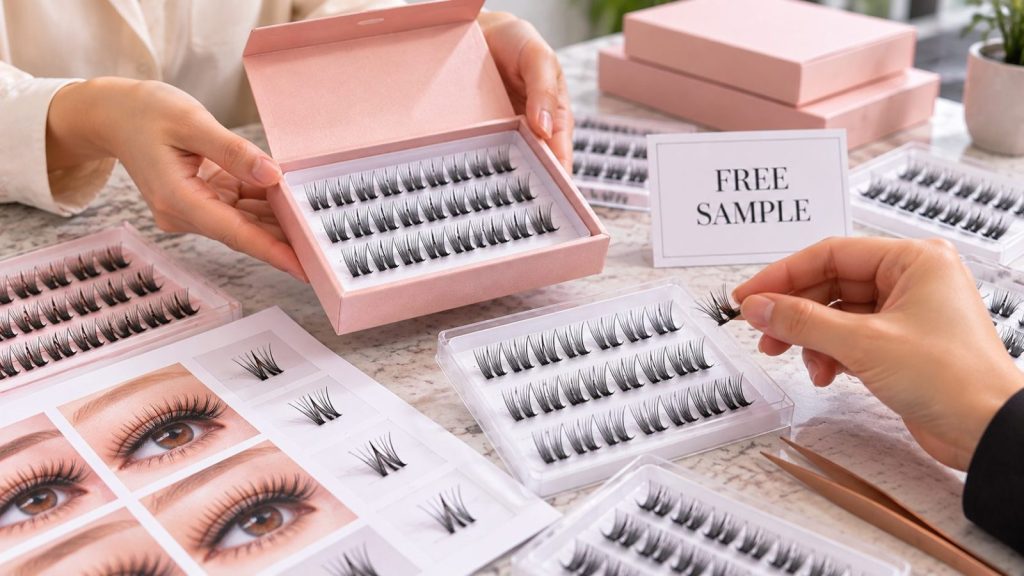
A lash supplier offering free samples may sound like a good deal, especially when you are comparing several manufacturers for the first time.
But free samples should never be the main reason you decide to trust a supplier.
A supplier can offer free products and still communicate poorly, delay shipping, avoid clear specifications or struggle to reproduce the approved sample during bulk production.
At the same time, a professional supplier may charge for samples or ask the buyer to cover international shipping and still be a much stronger long-term manufacturing partner.
The real question is not:
“Are the samples free?”
It is:
“What does the sample process tell me about how this supplier will handle my future orders?”
A Recent Buyer Experience: The Sample Was Not the Real Problem
One of our recent customers decided to change lash suppliers after experiencing repeated problems with her existing supplier.
As part of the transition, she needed the existing supplier to send product samples so the product could be evaluated and used as a reference.
The supplier agreed to provide the samples.
But the process quickly became difficult.
The shipment was sent freight collect, the dispatch was delayed, and the customer experienced additional difficulties during the process.
The important point is that freight collect by itself is not necessarily a warning sign.
It is normal in international B2B sourcing for a supplier to provide the product sample at no charge while the buyer pays the courier cost.
The concern comes from the complete experience:
- Was the shipping arrangement explained clearly in advance?
- Was the promised shipping date respected?
- Did the supplier communicate honestly about delays?
- Did the supplier cooperate when the buyer needed product information or samples?
- Did the process become unnecessarily difficult?
For this buyer, the sample process reinforced the reasons she was already considering changing suppliers.
That is an important lesson for any beauty brand evaluating a new lash manufacturer.
The sample stage is not only a test of the lashes. It is also a test of the supplier.
Does “Free Sample” Really Mean Free?
Not always.
In international B2B sourcing, several sample arrangements are common.
For example:
- free product sample, buyer pays shipping
- buyer pays sample cost and shipping
- sample fee refunded or credited after a bulk order
- supplier covers both sample and shipping for selected customers
None of these policies automatically tells you whether a supplier is reliable.
A serious supplier may charge for a sample because preparing one or several customized products requires material, labor and development time.
Another supplier may offer free stock samples because the product cost is low and the samples are already available.
What matters is whether the policy is transparent before anything is shipped.
Red Flag 1: “Free Samples” Are Used as the Main Sales Pitch
Be cautious when a supplier focuses heavily on free samples but asks very few questions about your actual project.
If you are developing private label lashes, a useful supplier conversation should normally include questions about:
- the lash category you need
- your reference product or photo
- your target market
- the style or effect you want
- estimated quantity
- number of styles or SKUs
- whether you need private label branding
- whether you need custom packaging
If the entire conversation is only:
“We can send you free samples.”
that tells you very little about the supplier’s actual product-development ability.
Red Flag 2: Sample Costs or Shipping Terms Change After You Agree
A buyer paying international sample shipping is not unusual.
What is more important is whether the arrangement is clear from the beginning.
For example, a supplier should be able to explain:
- whether the product sample itself is free
- who pays the courier cost
- whether shipping is prepaid or freight collect
- which courier will be used
- whether there are additional sample-development charges
If the terms repeatedly change after the buyer agrees to receive the sample, that can make the sourcing process difficult and should be clarified before moving forward.
Red Flag 3: Sample Shipping Is Constantly Delayed Without a Clear Explanation
Production and shipping delays can happen.
A delay alone does not make a manufacturer unreliable.
The difference is communication.
A professional supplier should be able to tell the buyer:
- why the sample is delayed
- what has already been completed
- the revised expected completion date
- when the tracking number will be available
If the promised date keeps changing and the buyer must repeatedly chase the supplier for basic updates, that is useful information before placing a much larger order.
If communication is already difficult when only a few samples are involved, ask yourself what the process may look like when hundreds or thousands of products, packaging materials and shipping deadlines are involved.
Red Flag 4: The Supplier Sends Whatever Is Available Instead of What You Asked For
A free stock sample can be useful for checking basic product quality.
But it should not be confused with a development sample.
For example, you may ask for:
- a specific cluster lash style
- a certain strip lash effect
- a brown lash direction
- a particular curl or length combination
- a product similar to a reference photo
If the supplier simply sends random existing products because they are free, you may learn very little about whether the manufacturer can develop the product you actually want to sell.
Before ordering samples, confirm whether you are receiving:
- a stock sample
- a reference sample
- a customized development sample
- a production-confirmation sample
These samples serve different purposes.
Red Flag 5: The Supplier Cannot Explain How Bulk Production Will Follow the Approved Sample
This is one of the most important questions for a private label lash brand.
A beautiful sample has limited value if the supplier cannot reproduce the approved product consistently.
Before bulk production, ask:
“Will the approved sample be used as the reference for my bulk order?”
You should also confirm the important product details in writing.
Depending on the lash product, this may include:
- overall lash style
- length distribution
- curl direction
- density
- fiber appearance
- cluster or lash base
- band direction
- tray configuration
- packaging structure
- printed product information
You can also read our guide on why lash samples and bulk orders can sometimes feel different.
A Good Sample Can Still Come from a Difficult Supplier
This is another mistake first-time buyers sometimes make.
The sample looks good, so they assume the supplier must be good.
But one sample only answers part of the question.
You should also evaluate:
- response quality
- communication speed
- honesty about delays
- willingness to answer technical questions
- ability to understand reference products
- sample preparation time
- packaging coordination
- how feedback is handled
- whether specifications are recorded clearly
Think of the sampling stage as a small test order for the working relationship.
You are evaluating both:
Product quality + Supplier behavior.
What If Another Supplier Charges for Samples?
Do not automatically reject them.
A paid sample does not mean the supplier is worse.
For customized products, the supplier may need to spend time selecting materials, adjusting the lash structure, arranging a special tray or preparing packaging.
In some cases, charging a reasonable sample fee can also help both sides focus on serious product-development projects.
Instead of comparing suppliers only by sample price, compare what you actually receive.
For example:
- Is it the product you requested?
- Was the specification confirmed before production?
- Was the sample completed on time?
- Did the supplier explain any limitations?
- Can the sample be adjusted?
- Can the approved version be used as the bulk-production reference?
How Should You Evaluate a Lash Supplier During the Sample Stage?
A simple supplier evaluation can include five areas.
1. Product Understanding
Does the supplier understand what you are trying to develop?
If you send a photo or reference product, can they identify which parts need to be confirmed?
2. Communication
Are the answers clear and relevant?
Does the supplier tell you when something is not possible instead of simply saying yes to everything?
3. Sample Process
Are the sample cost, shipping cost and lead time explained before you proceed?
4. Product Consistency
Can the supplier explain how the approved sample will be translated into bulk production?
5. Cooperation
When you request information, photos, packaging details or adjustments, does the supplier cooperate professionally?
These points are more valuable than whether the first few lashes were free.
Should You Compare Samples from More Than One Supplier?
If you are still selecting a manufacturing partner, comparing more than one supplier can be useful.
But do not compare only the physical lashes.
Record:
- sample quality
- sample cost
- shipping cost
- response time
- sample lead time
- accuracy to your reference
- willingness to make adjustments
- packaging capability
- communication quality
Our guide on comparing lash samples from different suppliers explains this process in more detail.
What If You Are Changing From an Existing Lash Supplier?
If your current supplier is already causing quality, communication or delivery problems, samples can help you establish a clear reference before moving production elsewhere.
You may be able to provide a new manufacturer with:
- your current product
- an older approved product
- a product photo
- packaging
- specifications
- photos showing what changed
The objective is not simply to find another supplier who sends free samples.
The objective is to find a manufacturer that can understand the existing product, confirm the target quality and build a repeatable production standard.
See our guide on what to send when changing lash suppliers.
So, Can You Trust a Lash Supplier Offering Free Samples?
Possibly.
Free samples are not automatically suspicious.
They can be a normal sales and product-evaluation tool.
But they are also not proof that the supplier is reliable.
Do not choose a manufacturer because they offered the cheapest or easiest sample.
Instead, use the sample stage to answer a more important question:
“Do I want to work with this company when the order becomes larger, more customized and more important?”
If the supplier communicates clearly, follows the agreed process, understands your product, responds professionally to feedback and can explain how bulk production will follow the approved sample, those are much stronger trust signals than a free sample.
Test a New Lash Manufacturer with Pingdu Lashes
If you are developing a new lash product or changing from an existing supplier, you can send Pingdu Lashes your reference product, photos or current samples.
Tell us:
- what product you currently have
- what problems you want to solve
- what you want to keep the same
- what you want to change
- your target market
- estimated quantity
- whether you need private label packaging
We can then discuss the appropriate sample direction before you move toward bulk production.
Visit our Custom Lash Services page to discuss your project.
Conversation