Receiving a lash sample that looks good is not the same as approving a product for bulk production.
Before a beauty brand places a larger order, the sample should become a clear production reference. The buyer and manufacturer need to agree on what has actually been approved: the lash style, dimensions, construction, application performance, packaging and any requested changes.
This final approval step is especially important for private label brands managing multiple styles or SKUs. A small misunderstanding at the sample stage can become a much larger problem once bulk production begins.
If you are still comparing products from several manufacturers, first read our guide on how to compare lash samples from different suppliers. This guide focuses on the next step: approving the final sample before commercial production.
1. First, Confirm Which Sample Is Actually Approved
During product development, a brand may receive several versions of the same lash.
For example:
- Sample A may have the correct shape but too much density.
- Sample B may have improved density but the wrong band.
- Sample C may be the final approved version.
Before placing a bulk order, both sides should identify exactly which sample is the production reference.
Do not rely only on messages such as “use the last sample” or “same as before.”
A clearer approval record can include:
- Sample code
- Product or SKU name
- Approval date
- Reference photos
- Confirmed specifications
- Packaging version
- Any final modifications
This makes it easier to connect the commercial order to one specific approved product.
2. Approve the Lash Style, Not Just the General Look
A lash can look attractive in a photo while still differing from the product the brand intends to sell.
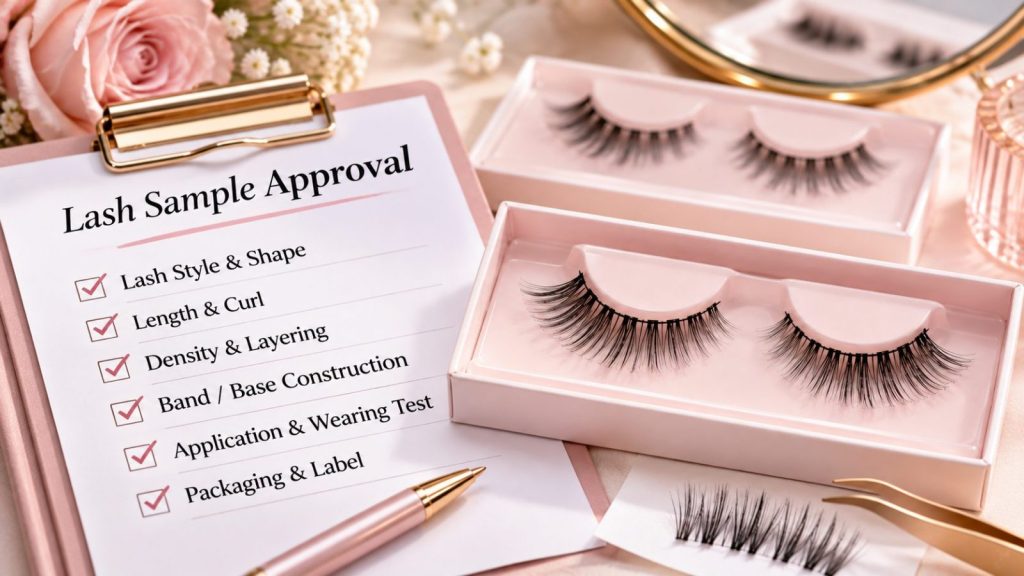
Final sample approval should check the actual design details.
Depending on the product category, these may include:
- Overall lash shape
- Fiber length
- Curl
- Density
- Layering
- Fiber direction
- Inner-to-outer length transition
- Spike position or pattern
- Color and surface finish
For strip lashes, the buyer may also need to confirm whether the product is natural, wispy, cat-eye, dramatic or another defined style.
For cluster lashes and professional lash extensions, the evaluation criteria may be different.
The important point is that the approved sample should represent the exact product direction that will be sold under the brand.
3. Check the Band, Base or Root Construction
The visible lash design is only part of the product.
The construction at the base can influence application, comfort and how the product performs in actual use.
For Strip Lashes
Check:
- Band length
- Band thickness
- Band flexibility
- Band color
- How the fibers are attached to the band
- Whether the left and right lashes are balanced
For DIY Cluster Lashes
Check:
- Base width
- Base thickness
- Flatness
- Ease of pickup
- Spacing between clusters
- Whether the base feels suitable during application
For Professional Lash Extensions
Check:
- Root consistency
- Fiber separation
- Pickup from the strip
- Curl consistency
- Length arrangement
- Fan-opening performance where applicable
The exact checklist should match the product category rather than using one generic standard for every lash product.
4. Test the Sample the Way the Customer Will Actually Use It
A product should not be approved only by looking at it inside the tray or box.
The final sample should also be tested under realistic application conditions.
For strip lashes, this may include:
- How easily the band follows the eyelid shape
- How the lash looks after application
- Whether the fibers maintain the intended direction
- Comfort during wear
- Whether the style looks balanced from different angles
For DIY clusters, buyers may check pickup, placement, layering and final appearance.
For professional extensions, lash artists may need to evaluate pickup, fanning behavior, curl and handling.
Physical testing is important because some differences are difficult to judge from supplier photographs alone.
5. Approve More Than One Piece When Possible
One perfect lash pair or one perfect tray does not automatically show whether the product is consistent.
Before bulk production, brands can examine several pieces from the same sample batch.
Check whether there are noticeable differences in:
- Shape
- Density
- Length
- Curl
- Band or base construction
- Fiber direction
- Tray arrangement
The objective is not to expect every handmade beauty product to appear mathematically identical. The objective is to understand whether the overall product remains within the brand’s accepted appearance and specification.
6. Separate “Must Match” Requirements from Minor Acceptable Variation
Not every product characteristic has the same importance.
Before production, brands should identify which features are essential.
| Approval Area | Example of What to Confirm |
|---|---|
| Product Identity | Correct style, SKU and product type |
| Visual Design | Shape, density, layering and overall effect |
| Core Specification | Required length, curl, thickness or band type |
| Application | Product performs as intended during use |
| Packaging | Correct box, tray, logo and product information |
| Branding | Correct artwork version and SKU identification |
This helps prevent a situation where a minor visual difference receives more attention than a specification that actually affects the product.
7. Confirm Any Changes Made After the First Sample
Many private label products require more than one development round.
A buyer may ask for:
- Shorter fibers
- Lower or higher density
- A different curl
- A softer band
- A different cluster base
- A different tray configuration
- Packaging adjustments
If changes were requested, the final approval should clearly identify which revisions have been accepted.
Do not assume that a written change automatically means the physical result has been approved.
The safest sequence is:
- Request the modification.
- Receive or review the revised sample.
- Confirm the revised version.
- Record that version as the final production reference.
8. Approve Packaging Separately from the Lash Product
A correct lash sample does not automatically mean the packaging is ready for production.
Private label projects may involve separate approvals for:
- Box size and structure
- Tray layout
- Logo placement
- Printing
- Product name
- SKU code
- Barcode area
- Instructions or product information
If your brand wants to review branded packaging before placing the first order, see our guide on reviewing logo and packaging samples before a private label lash order.
Product approval and packaging approval should be treated as connected but separate steps.
9. Make Sure Every SKU Has Its Own Reference
This becomes especially important when a brand orders several lash styles at the same time.
For example, a collection may include:
- Natural strip lashes
- Wispy strip lashes
- Cat-eye styles
- Cluster lash kits
- Different extension curls or lengths
Each SKU should be linked to its own sample code, specifications and packaging version.
A common risk in multi-SKU orders is not necessarily poor manufacturing. It can be confusion between similar products, labels or packaging versions.
Clear SKU-level approval helps reduce this risk before production starts.
10. Keep an Approved Reference for Repeat Orders
The first bulk order is not the end of sample approval.
The approved product also becomes useful when the brand places future repeat orders.
Useful reference records may include:
- Approved physical sample
- Sample code
- Specification sheet
- Reference photographs
- Packaging artwork version
- Product labels
- Confirmed modifications
When repeat orders are placed months later, these records make it easier for both the brand and manufacturer to identify the original approved product.
This is particularly important for brands that want consistent products across multiple orders.
11. Do Not Use Price Approval as Product Approval
Commercial quotation and product approval are two different decisions.
A buyer may agree with a price while some product details are still under development.
Before moving into bulk production, confirm that the product itself has been approved rather than assuming that accepting the quotation also means accepting the latest sample.
The order should connect the agreed commercial terms with the correct approved product reference.
12. Create a Simple Final Sample Approval Checklist
The process does not need to be complicated.
A simple final checklist can help brands avoid missing important details.
| Item | Final Check |
|---|---|
| Sample Code | Is the correct final sample clearly identified? |
| Style | Does the overall lash effect match the approved design? |
| Specifications | Are the required length, curl, density and other key details confirmed? |
| Band / Base / Root | Is the construction correct for the selected product? |
| Application | Has the product been tested in realistic use? |
| Consistency | Have several pieces been reviewed where appropriate? |
| Packaging | Is the correct packaging version approved? |
| SKU | Does each product have the correct identification? |
| Changes | Have all requested revisions been confirmed? |
| Production Reference | Is there a clear record for bulk and repeat orders? |
13. Sample Approval Is Also Part of Supplier Management
A well-managed approval process does more than confirm the appearance of the product.
It also shows whether the buyer and manufacturer can communicate specifications clearly before larger quantities are produced.
For brands evaluating a long-term production partner, you can also read our guide on how established beauty brands evaluate lash manufacturers for long-term OEM supply.
If your brand is still deciding which lash categories to develop, browse our wholesale lash product range.
14. Private Label Sample Development with Pingdu Lashes
Pingdu Lashes works with beauty brands, wholesalers and distributors developing private label strip lashes, cluster lashes and professional lash extension products.
Depending on the project, buyers can provide:
- A physical reference sample
- Product photographs
- Target specifications
- Requested modifications
- Packaging artwork
- Target quantities
- SKU requirements
Samples can then be used to confirm the product direction before commercial production.
For customized lash products and branded packaging, learn more about our OEM and private label eyelash services.
Frequently Asked Questions
Is one lash sample enough before bulk production?
It depends on the product and project. Reviewing more than one piece or tray can provide a better understanding of consistency before approval.
Should I approve the lash and packaging at the same time?
They can be reviewed during the same project, but the product and packaging should each have a clearly approved version.
What if I want to change something after approving the sample?
The change should be documented and, where necessary, a revised sample should be reviewed before production follows the new specification.
Should every SKU have a separate approved sample?
For products with different styles or specifications, keeping separate references makes production and future repeat orders easier to manage.
Can I use my existing product as a reference sample?
Yes. A physical reference product can help communicate the target style, construction and specifications more clearly when developing a private label product.
What is the main purpose of final sample approval?
The purpose is to create a clear production reference so that the buyer and manufacturer understand exactly which product, specifications and packaging should be used for bulk production.
Final Thoughts
A good sample is the beginning of bulk-order approval, not the end of it.
Before production starts, beauty brands should clearly confirm the final product style, important specifications, application performance, packaging, SKU information and any requested revisions.
The more clearly the approved sample is documented, the easier it becomes to manage bulk production and future repeat orders.